Yaday Capital Participates in AMI Labs’ Record-Breaking AI Funding Round
Paris, 10 March 2026.
Yaday Capital announces its participation in the funding round of AMI Labs, the artificial intelligence company founded by Turing Award laureate and former Meta Chief AI Scientist Yann LeCun.
AMI Labs has raised more than $1 billion (approximately €890 million), marking the largest seed round ever raised by a European startup and reflecting strong global investor interest in the company’s vision for the next generation of artificial intelligence.
The round was co-led by Cathay Innovation, Greycroft, Hiro Capital, HV Capital and Bezos Expeditions, with participation from global investors including Nvidia, Temasek, Samsung, Sea, Toyota Ventures and SBVA, alongside European industrial and technology groups such as Publicis Groupe, Bpifrance Digital Venture, Artémis, Aglaé Ventures, Groupe industriel Marcel Dassault and Association Familiale Mulliez.
Individual investors include Tim Berners-Lee, Jim Breyer, Mark Cuban, Mark Leslie, Xavier Niel and Eric Schmidt.
Initially targeting a €500 million raise, the company ultimately secured close to €890 million in commitments, allowing AMI Labs to assemble a global investor base aligned with its long-term research and technology ambitions.
The launch of AMI Labs also highlights their global ambition in shaping the next phase of artificial intelligence from its hubs in Paris, New York, Montreal and Singapore.
A New Approach to Artificial Intelligence
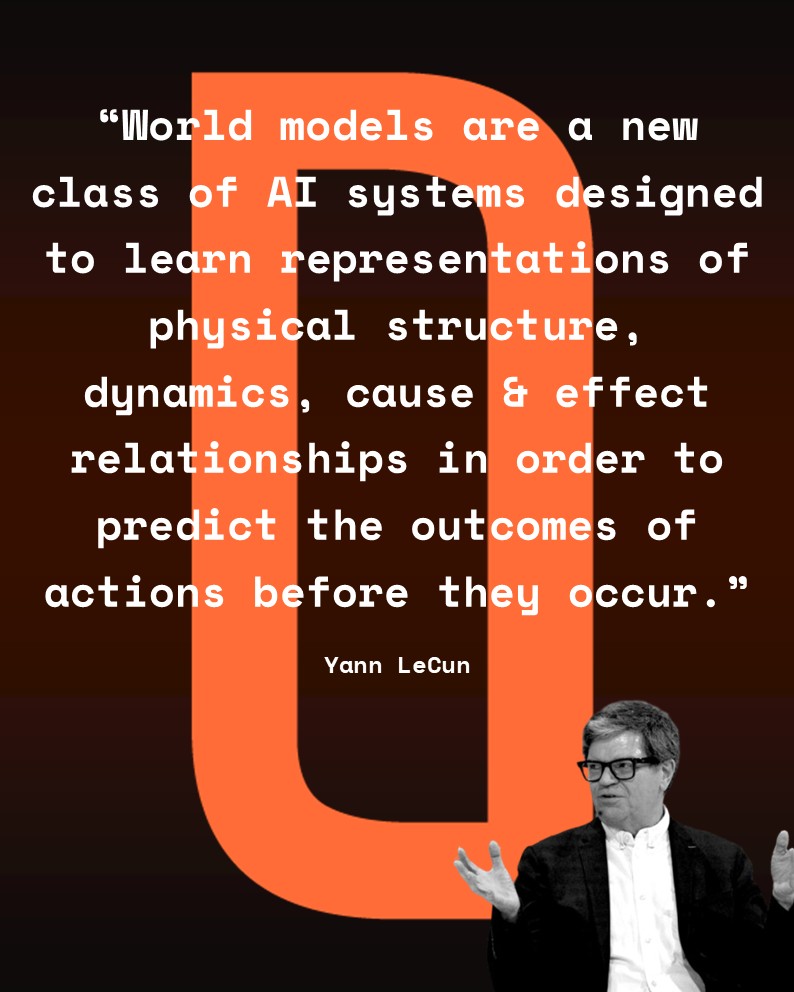
AMI Labs is developing a new class of artificial intelligence systems known as world models.
Unlike large language models (LLMs), which primarily generate text or images, world models aim to learn representations of the physical world and predict how situations evolve, allowing machines to reason about cause and effect and plan actions under real-world constraints.
Such systems could enable new capabilities across fields including robotics, autonomous mobility, industrial automation and scientific research. The company plans to develop its own model architecture, AMI Video, designed to help machines interpret and interact with complex environments.
AMI Labs will build its research and engineering teams across four global hubs: Paris, New York, Montreal and Singapore.
The company is led by Alexandre LeBrun, former CEO of medical AI company Nabla, with Yann LeCun serving as Executive Chair. The leadership team also includes Laurent Solly, former Vice President for Europe at Meta (COO), Saining Xie (Chief Science Officer), Pascale Fung (Chief Research & Innovation Officer) and Michael Rabbat (VP of World Models).
Building the Next Generation of AI
The funding will primarily support compute infrastructure and the recruitment of leading AI researchers, two critical components in the development of next-generation AI systems.
While the company does not expect to generate revenue in the near term, it plans to collaborate with early partners to test its models in real-world environments. Healthcare AI company Nabla is among the first disclosed partners exploring potential applications.
AMI Labs also plans to publish research and release portions of its technology as open source, contributing to the broader AI research ecosystem.
Yaday Capital’s Perspective
For Yaday Capital, the investment reflects its strategy of backing companies building the next generation of Applied AI and foundational intelligent systems.
Pauline Bovyn, Co-Founder and Co-CEO at Yaday Capital, commented:
“The first wave of AI has been largely driven by large language models. The next frontier will come from systems capable of understanding and interacting with the physical world.
AMI Labs represents one of the most ambitious efforts globally to develop this new generation of AI architectures. Supporting visionary teams working at the frontier of research and adoption is central to Yaday’s investment strategy.”
Yaday Capital is an early-growth venture fund, with Applied AI at the core of the investment thesis. We act as strategic partners, accelerators and investors by backing AI visionaries of tomorrow, supporting companies building transformative technologies across Europe, the United States and the Middle East.